Understanding MiCA: Why USDT Is Restricted in Europe and What the Rules Mean for Crypto
Published 30 August 2026
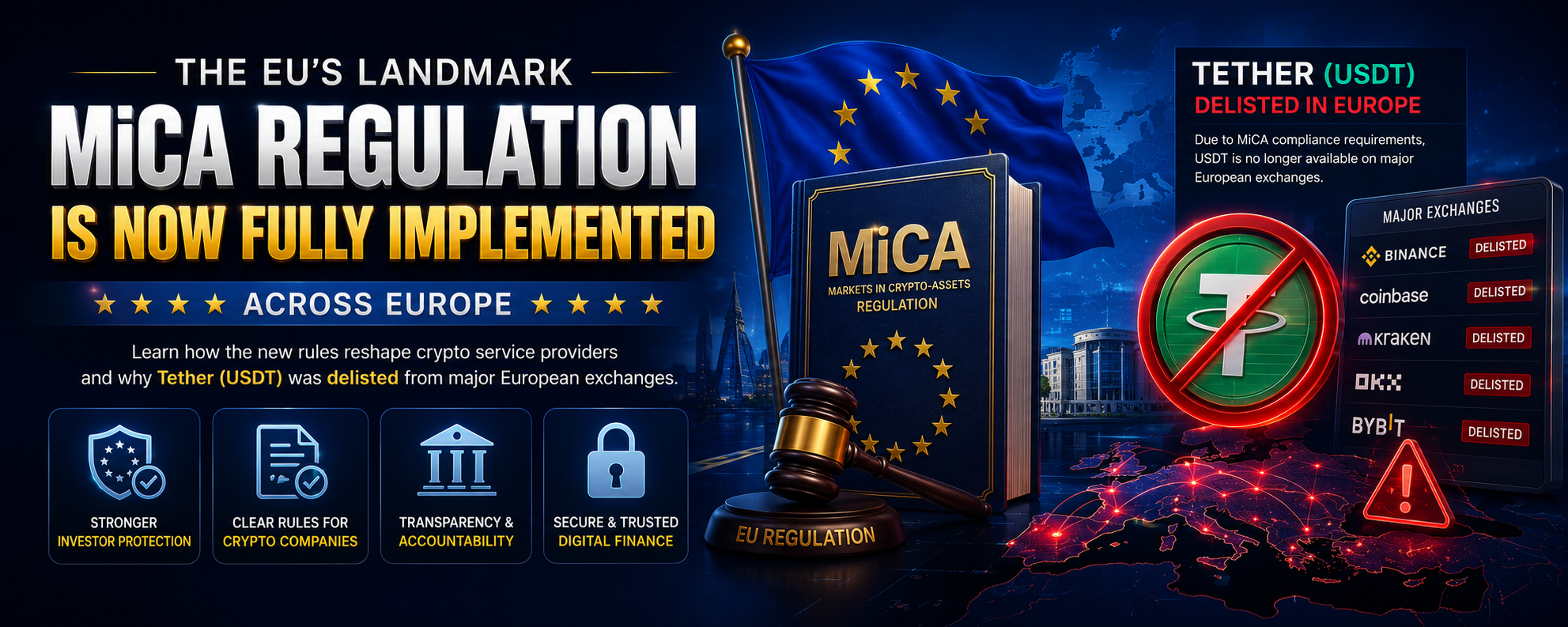
The EU's landmark MiCA regulation is officially fully implemented across Europe. Learn how the new rules reshape crypto service providers and why Tether (USDT) was delisted from major European exchanges.
Understanding MiCA: Why USDT Is Restricted in Europe and What the Rules Mean for Crypto
The European Union introduced Regulation (EU) 2023/1114, widely known as the Markets in Crypto-Assets (MiCA) regulation, to establish a unified legal framework across all member states. Designed to replace a fragmented landscape of national rules, MiCA focuses on protecting retail investors, ensuring financial stability, and maintaining market integrity. Stablecoin rules took effect on June 30, 2024, followed by complete provider requirements on December 30, 2024, and the final EU-wide transitional period ended on July 1, 2026.
Under MiCA, digital assets are categorized into Asset-Referenced Tokens (ARTs), Electronic Money Tokens (EMTs), and general crypto-assets. Crypto-Asset Service Providers (CASPs)—including custodians and exchanges—must obtain authorization from a national regulatory body to operate within the bloc. Crucially, MiCA introduces a passporting mechanism, allowing licensed providers to serve customers across the entire European Union with a single license, provided they meet strict capital, governance, and asset segregation requirements.
The primary reason USDT (Tether) is restricted on regulated EU exchanges is that Tether deliberately chose not to apply for an Electronic Money Token (EMT) license under MiCA. Tether’s leadership publicly criticized MiCA's strict mandate requiring stablecoin issuers to hold at least 60% of their reserves in cash deposits at European banks, arguing it introduces systemic banking risks. Because offering unauthorized stablecoins jeopardizes an exchange's license, major platforms like Coinbase, Binance, Crypto.com, and Kraken delisted USDT trading pairs for European users. While EU individuals can still legally hold or transfer USDT in self-custody wallets and on-chain protocols, regulated European exchanges are legally prohibited from offering or trading it.